
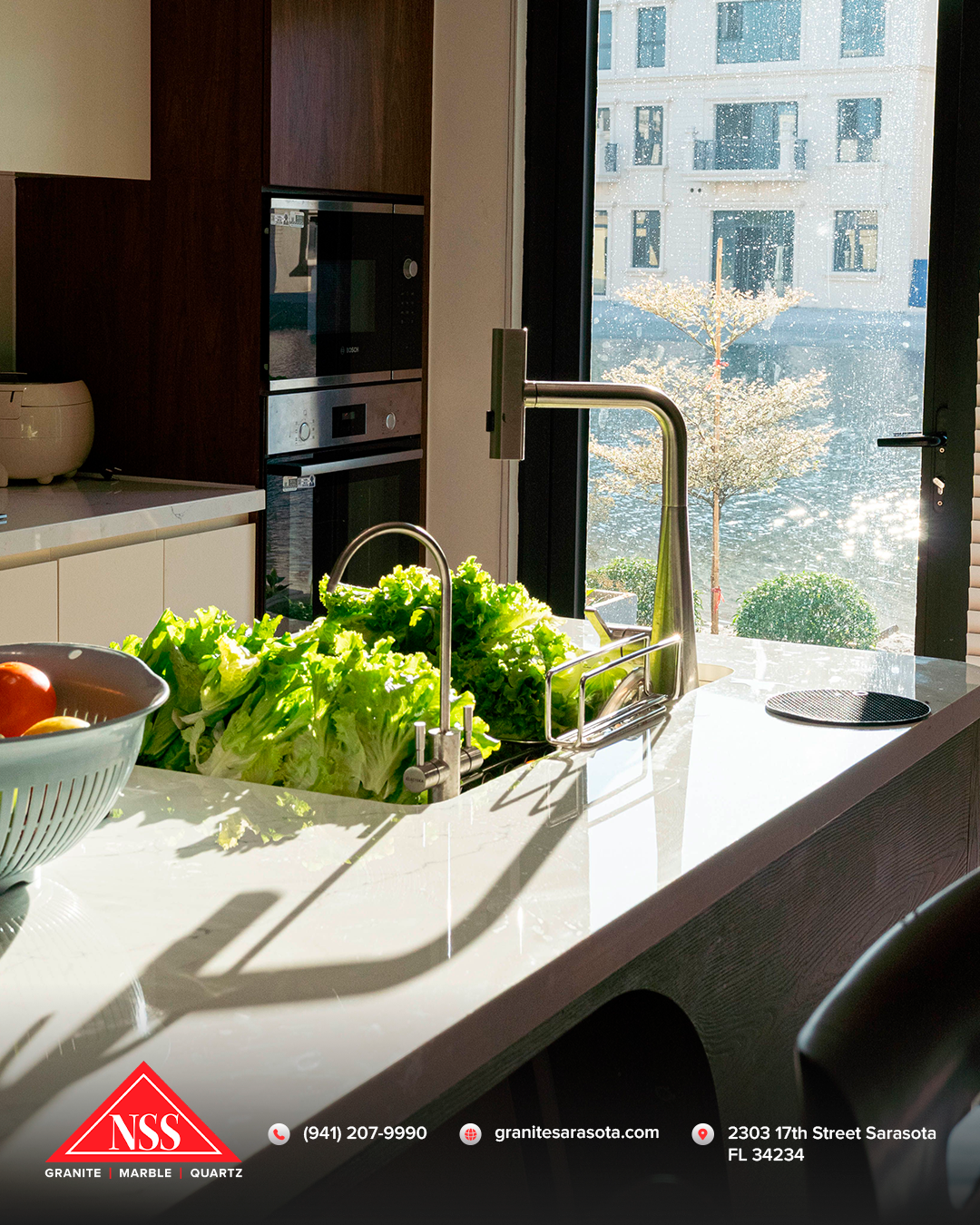
Before countertop templating, homeowners should ask whether cabinets are fully installed, whether the sink and appliances are final, where seams may land, which edge profile is chosen, and whether backsplash details are confirmed. Templating is the measurement step that turns a countertop idea into a fabrication plan, so unclear decisions can affect price, timing, seams, cutouts, and installation.
We explain this often to homeowners comparing granite countertop stores in Venice Gardens, FL because many countertop problems start before the stone is ever cut. At NSS, we want the templating appointment to confirm the project, not expose missing decisions that delay fabrication.
What Is Countertop Templating?
Countertop templating is the precise measuring process used to create the layout for fabrication.
During templating, the technician measures the cabinets, walls, sink area, appliance openings, overhangs, corners, and special details. The template tells the fabrication team where to cut, polish, drill, seam, and shape the material.
| Templating detail | Why it matters |
|---|---|
| Cabinet measurements | Determines exact countertop shape |
| Wall conditions | Helps avoid gaps and fit issues |
| Sink position | Controls cutout placement |
| Appliance openings | Prevents fit problems |
| Overhangs | Affects comfort and support |
| Seam locations | Impacts appearance and strength |
A good template protects both the stone and the installation schedule.

Are the Cabinets Installed, Level, and Secured?
Yes, cabinets should be fully installed, level, secured, and permanent before templating.
Countertops are fabricated to fit the cabinets as they exist on template day. If cabinets move later, the stone may not fit correctly. Even a small shift can affect sink alignment, wall gaps, seams, and overhangs.
Before scheduling templating, homeowners should confirm that base cabinets, island cabinets, panels, fillers, end panels, and supports are finished. Temporary cabinets or loose sections create risk.
Is the Sink Final Before Templating?
Yes, the sink should be selected and available before templating whenever possible.
Sink details affect the cutout size, reveal, faucet placement, support, and cabinet clearance. An undermount sink needs a polished opening. A farmhouse sink needs careful front alignment and cabinet planning. A drop-in sink has different requirements.
For homeowners working with granite countertop stores in Venice Gardens, FL, we recommend having the sink model, specification sheet, and actual sink ready before the template appointment. Guessing the sink size can cause fabrication delays.
Are the Faucet, Soap Dispenser, and Accessories Final?
Yes, faucet and accessory decisions should be final because every hole drilled into stone is permanent.
A standard bathroom vanity may need one faucet hole or three faucet holes. A kitchen may need holes for a faucet, soap dispenser, air switch, filtered water faucet, or cup rinser. These details must be planned before fabrication.
| Fixture or accessory | Templating question |
|---|---|
| Main faucet | Single-hole or widespread? |
| Soap dispenser | Left or right of faucet? |
| Air switch | Near sink or hidden? |
| Filtered water faucet | Separate hole needed? |
| Cup rinser | Enough deck space? |
| Vanity faucet | 4-inch or 8-inch spread? |
Once stone is fabricated, changing hole locations is difficult and sometimes impossible.
Are the Cooktop and Appliances Confirmed?
Yes, cooktops, ranges, refrigerators, dishwashers, and other appliances should be confirmed before templating.
Cooktops require exact cutout dimensions. Slide-in ranges need proper side clearance. Dishwashers may need mounting coordination. Refrigerators can affect side panels and countertop ends.
For kitchens near Venice Gardens, FL, this matters especially when a project includes older cabinets, appliance upgrades, or layout changes. Appliance dimensions should be checked before measurements are finalized.
Where Will the Seams Be Placed?
Seam placement should be discussed before fabrication because it affects the finished look and the structural plan.
Seams are sometimes necessary because slabs have size limits, layouts have turns, and certain materials have movement that needs careful matching. A large island may need one slab if the selected material allows it, while a long perimeter run may require a seam.
| Seam factor | Why it matters |
|---|---|
| Slab size | Limits how large each piece can be |
| Material pattern | Veins may need alignment |
| Sink location | Seams near sinks are often avoided |
| Cabinet support | Stone needs stable base below |
| Installation access | Large pieces must fit through the home |
A seam is not automatically a flaw. A poorly planned seam is the problem.
Which Edge Profile Should You Choose?
The edge profile should be chosen before fabrication because it changes the final appearance and cost.
Simple eased and pencil edges are clean, practical, and usually cost-efficient. Decorative edges like ogee or laminated edges may require more fabrication time and may feel more traditional. Mitered edges can make stone look thicker but usually cost more.
| Edge profile | Visual style | Cost impact |
|---|---|---|
| Eased edge | Simple and modern | Low |
| Pencil edge | Soft and practical | Low |
| Beveled edge | Crisp detail | Low to moderate |
| Half bullnose | Rounded and classic | Moderate |
| Ogee | Decorative and formal | Moderate to high |
| Mitered edge | Thick and custom | High |
We review edges with the material because some edges look better on granite, quartz, marble, or quartzite depending on pattern and thickness.
Is the Backsplash Plan Final?
Yes, the backsplash plan should be discussed before templating because it can affect measurements, wall details, and material quantity.
Some homeowners choose no stone backsplash because they plan to install tile later. Others choose a 4-inch stone backsplash, a side splash, a full-height backsplash, or a waterfall panel. Each option changes fabrication needs.
| Backsplash choice | Budget and planning impact |
|---|---|
| No backsplash | Tile planned separately |
| 4-inch stone splash | Simple and practical |
| Side splash | Useful against side walls |
| Full-height stone backsplash | Higher material and fabrication cost |
| Waterfall panel | Requires precise layout and support |
Backsplash decisions should not be treated as an afterthought. They change the final look and sometimes the slab count.
How Much Should You Budget Before Templating?
Homeowners should budget based on full installed cost, not only the slab price.
Stone countertops typically range from about $45-$200+ per square foot installed, depending on material, layout, cutouts, edges, backsplash, delivery, and installation conditions.
| Material | Typical installed range |
|---|---|
| Granite | $45-$120+ per sq. ft. |
| Quartz | $55-$140+ per sq. ft. |
| Marble | $70-$180+ per sq. ft. |
| Quartzite | $80-$200+ per sq. ft. |
The final price depends on square footage, slab quantity, sink and cooktop cutouts, faucet holes, edge profile, seams, backsplash height, removal, access, and sealing when needed.
Homeowners comparing granite countertop stores in Venice Gardens, FL should ask whether the estimate includes templating, fabrication, cutouts, delivery, installation, and final care guidance. At NSS, we review those details before fabrication so the project scope is clear.
What Should Be Ready on Template Day?
The main goal is to make sure all permanent project details are ready and visible.
A good template appointment works best when the technician can measure the real installed conditions, not future guesses.
When working with granite countertop stores in Venice Gardens, FL, this checklist can prevent avoidable changes after measurement:
- Cabinets are installed, level, and secured
- Sink model and specifications are final
- Faucet and accessory holes are planned
- Cooktop or range dimensions are available
- Overhangs and support brackets are discussed
- Edge profile is selected
- Backsplash plan is confirmed
- Existing countertops are removed if required
- Appliances are onsite or specifications are ready
This preparation keeps the project moving from measurement to fabrication with fewer surprises.
How Long Does Fabrication Take After Templating?
Most countertop projects take about 10-14 business days from final templating to installation.
Smaller bathroom vanity or remnant projects may sometimes fit a 7-14 business day window, depending on material availability and project details. Larger kitchens, full-height backsplashes, waterfall panels, special orders, or layout revisions can take longer.
| Project stage | Typical timing |
|---|---|
| Material selection | 1-5 days |
| Digital templating | One appointment |
| Slab layout review | 1-2 days if needed |
| Fabrication | 5-10 business days |
| Installation | Usually one day |
| Plumbing reconnection | Same day or next day |
For projects sourced through granite countertop stores in Venice Gardens, FL, the timeline depends on how complete the decisions are before template day. Missing sink specs, appliance changes, or backsplash revisions can push the schedule back.
What Mistakes Cause Templating Delays?
The most common delays come from unfinished cabinets, missing sink information, changed appliances, undecided edges, and unclear backsplash plans.
We recommend avoiding:
- Scheduling templating before cabinets are secured
- Changing the sink after template day
- Guessing cooktop dimensions
- Forgetting faucet accessory holes
- Choosing edge profile too late
- Ignoring support for large overhangs
- Approving stone before reviewing slab movement
- Treating backsplash as a later decision
At NSS, we would rather slow down before cutting than rush a project with missing details. Stone fabrication is precise, and precision depends on final information.
What Should You Ask the Countertop Team Before They Measure?
You should ask what must be finalized, what affects pricing, where seams may go, how long fabrication will take, and what could delay installation.
Useful questions include:
- Do my cabinets look ready for templating?
- Do you need the actual sink onsite?
- Which appliance specifications are required?
- Where do you expect seams to land?
- Which edge profiles fit my material and budget?
- Is my overhang safe without extra support?
- Will backsplash be measured now or later?
- What happens if I change fixtures after templating?
These questions help the homeowner understand the process before the stone is cut.

FAQ
What is countertop templating?
Countertop templating is the precise measuring step used to create the fabrication layout for the stone.
Should cabinets be installed before templating?
Yes. Cabinets should be installed, level, secured, and permanent before templating.
Do I need my sink before templating?
Yes, the sink model and specifications should be final. Having the actual sink onsite is often best.
Can I change my faucet after templating?
Only if the hole layout still works. Faucet and accessory holes should be finalized before fabrication.
How long does fabrication take after templating?
Most countertop projects take about 10-14 business days after final templating.
What affects countertop price after templating?
Material, square footage, cutouts, seams, edge profile, backsplash, delivery, access, and sealing can affect price.
Can templating happen before appliances arrive?
Sometimes, but exact appliance specifications are needed. Cooktops and slide-in ranges require careful planning.
About NSS
We are located at 2303 17th Street, Sarasota, FL 34234. Homeowners can reach us at (941) 207-9990.
From Sarasota, FL, we serve Venice Gardens, FL and nearby communities with material selection, finish comparison, digital templating, slab layout planning, custom fabrication, sink and cooktop cutouts, faucet-hole drilling, edge finishing, backsplash fabrication, sealing, delivery, and professional installation. We work with granite, quartz, marble, and quartzite for kitchens, islands, bathrooms, vanities, laundry counters, waterfall panels, and other residential surfaces.
For homeowners comparing granite countertop stores in Venice Gardens, FL, NSS helps prepare the right questions before templating, confirm project details, review pricing, plan fabrication, and keep installation timing as clear as possible.