

One black granite can be easier to maintain than another because black stone varies in density, mineral composition, porosity, finish, and sensitivity to oils or cleaning residue. Two slabs may look nearly identical in a showroom but behave differently around water, fingerprints, cooking oil, and daily wiping.
We explain this difference when homeowners compare granite countertops in Venice Gardens, FL. At NSS, we look beyond the color name and evaluate the actual slab, finish, expected use, and maintenance routine before fabrication begins.
Are All Black Granites the Same Material?
No, stones sold commercially as black granite do not all have the same mineral structure or absorption rate.
Some black slabs are extremely dense and absorb very little liquid. Others contain a more open mineral structure, small fissures, or lighter crystalline areas that respond differently to moisture and sealer.
| Stone characteristic | Easier-maintenance result | More demanding result |
|---|---|---|
| Very low absorption | Less darkening from water or oil | More frequent sealer checks |
| Even mineral structure | Predictable cleaning | Mixed areas absorb differently |
| Fine, consistent pattern | Hides some crumbs and streaks | Solid color reveals more marks |
| Stable finish | Uniform sheen | Uneven polish shows haze |
For granite countertops in Venice Gardens, FL, we recommend evaluating the specific slab rather than relying only on a sample label.
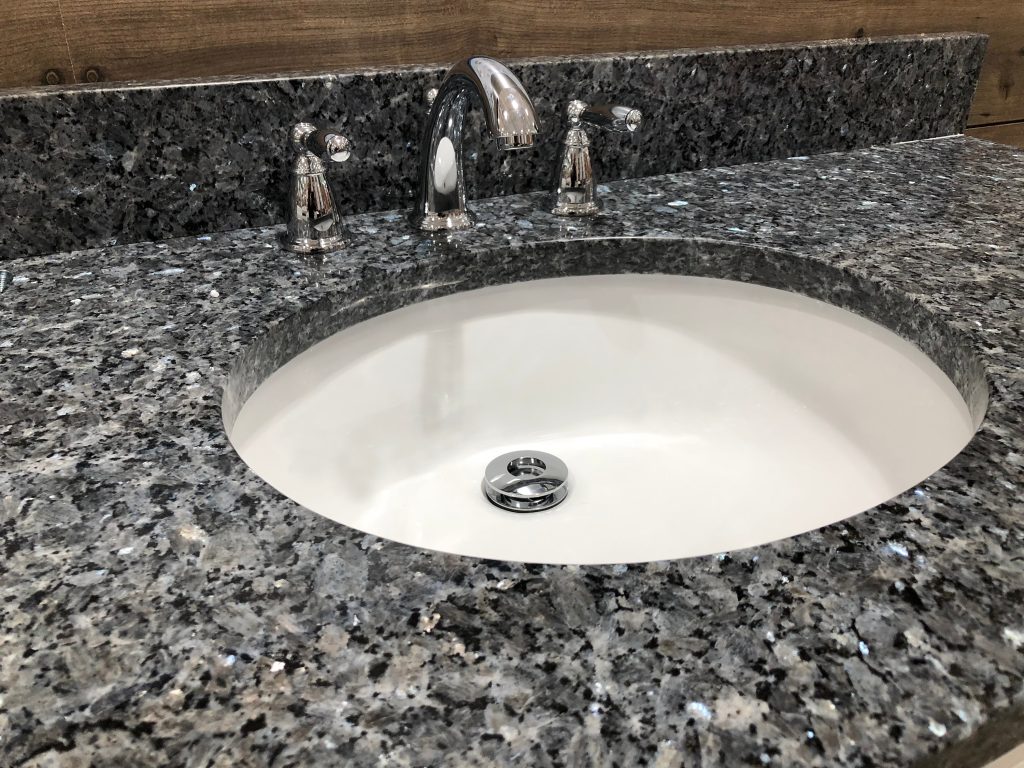
Why Does Density Matter?
Denser black granite usually absorbs less water and oil, which reduces staining risk and simplifies maintenance.
Less-dense stone can still perform well, but it may need more careful sealing and faster spill cleanup.
We often use a simple water test. If the stone darkens after water sits for 10–15 minutes, it may be absorbing moisture and could need sealer.
Does Solid Black Granite Show More Dirt?
Yes, a nearly solid black surface often shows fingerprints, dust, water spots, and wiping streaks more clearly than patterned black granite.
Under pendant lights, a handprint that is invisible from one angle may become obvious from another.
| Surface appearance | What it tends to show | Best daily routine |
|---|---|---|
| Solid polished black | Fingerprints and streaks | Dry with microfiber |
| Fine-speckled black | Fewer visible crumbs | Wipe with mild soap |
| Honed black | Oil and contact marks | Clean promptly |
| Leathered black | Less glare and fewer prints | Wipe across the full surface |
Is Polished Black Granite Easier to Clean?
Polished black granite is usually the easiest to wipe, but not always the easiest to keep visually spotless.
Its smooth finish releases crumbs and grease easily, but the reflective surface highlights hard-water spots, fingerprints, and cleaner residue.
We often see homeowners use too much cleaner to remove haze. Excess product dries into another film and makes the surface look cloudy.
At NSS, we usually recommend a small amount of mild dish soap or pH-neutral stone cleaner, followed by a clean-water wipe and complete drying.
Is Honed Black Granite More Difficult?
Honed black granite can require more attention because oils may darken the low-sheen surface.
The matte finish reduces glare, but hand oils, grease, lotion, or soap may appear as darker areas. Any enhancing sealer should be tested first because it changes the appearance.
Homeowners considering granite countertops in Venice Gardens, FL should handle a honed sample before selecting it. A perfectly clean display does not show how the surface will react to daily use.
Does Leathered Black Granite Hide Marks Better?
Leathered black granite often hides fingerprints and water spots better, although texture requires more complete wiping.
The surface scatters light instead of reflecting it flatly. Deep texture can collect flour, dried sauce, or cosmetic residue.
| Finish | Fingerprint visibility | Cleaning effort | Visual effect |
|---|---|---|---|
| Polished | High on solid black | Low | Crisp and reflective |
| Honed | Moderate; oils may darken | Moderate | Soft and modern |
| Leathered | Low to moderate | Moderate | Textural and natural |
| Brushed | Low | Moderate to higher | Rustic and tactile |
Why Can Black Granite Look Cloudy After Sealing?
Cloudiness usually comes from excess sealer, incompatible products, uneven application, or residue left on the surface.
Dense black stone may absorb very little product. If too much sealer is applied and not removed within the proper working time, it can dry on top as haze.
More sealer is not better. At NSS, we determine whether the slab needs sealing before treatment and remove excess according to the product instructions.
How Often Should Black Granite Be Sealed?
Black granite should be sealed according to absorption, not an automatic calendar date.
Some dense slabs may go several years without treatment, while others should be tested annually around sinks and preparation zones.
If water remains on the surface without darkening it after 10–15 minutes, immediate resealing may not be necessary.
Why Are Hard-Water Spots So Visible?
Hard-water spots are visible because pale mineral deposits create strong contrast against a dark background.
This is common near faucets, coffee machines, and dish-drying areas. In Venice Gardens, FL, humid conditions can keep those areas damp longer.
We recommend wiping the faucet area dry, repairing drips, and removing deposits before they harden. For granite countertops in Venice Gardens, FL, a softly patterned slab may disguise occasional spotting better than a uniform black surface.
Can Cooking Oil Permanently Darken Black Granite?
Yes, cooking oil can penetrate inadequately sealed or more absorbent granite and create a darker patch.
Trays under oil bottles and frequently used condiments help prevent repeated exposure.
A fresh stain may respond to a poultice. Older absorbed oil can require several treatments.
Which Cleaners Make Black Granite Harder to Maintain?
Products that leave wax, silicone, soap film, or abrasive residue make black granite look streaky and uneven.
Glass cleaner, furniture polish, vinegar mixtures, and heavy degreasers are unnecessary for routine care.
Our practical routine is:
- Remove crumbs with a dry cloth.
- Use mild soap or stone-safe cleaner.
- Wipe the entire area, not only one spot.
- Rinse away cleaner residue.
- Dry with a separate microfiber cloth.
A clean black surface often looks worse when too many products have been layered onto it.
How Does Black Granite Compare With Black Quartz?
Black quartz requires no sealing, while black granite usually offers better heat resistance and natural mineral depth.
Quartz is non-porous and resists many stains, but solid black quartz can show fingerprints and streaks just as clearly. Granite tolerates heat well, although we still recommend trivets.
| Material | Sealing | Heat resistance | Main maintenance issue |
|---|---|---|---|
| Black granite | Often required | Excellent | Water spots and sealer haze |
| Black quartz | Not required | Moderate | Fingerprints and heat |
| Dark marble | Usually required | Good | Etching |
| Dark quartzite | Usually required | Excellent | Sealing and mineral variation |
Which Black Surface Is Best for a Busy Household?
A fine-patterned polished or lightly leathered black granite is often the most forgiving choice.
It combines strong heat resistance with enough movement to hide water spots, crumbs, and handprints. Solid polished stone demands more frequent drying.
The best choice depends on habits. A household that cooks several times daily may prioritize heat resistance, while a low-use bar can support a more uniform finish.
How Much Do Black Granite Countertops Cost?
Black granite generally costs about $45–$120 or more per square foot installed.
Honing, leathering, premium edges, and complex layouts can add cost.
| Material | Typical installed range |
|---|---|
| Granite | $45–$120+ per sq. ft. |
| Quartz | $55–$140+ per sq. ft. |
| Marble | $70–$180+ per sq. ft. |
| Quartzite | $80–$200+ per sq. ft. |
At NSS, we prepare estimates after reviewing square footage, slab quantity, finish, cutouts, edge profile, seams, backsplash, removal work, delivery, and site access.
What Is Included in Fabrication and Installation?
Professional fabrication includes measuring, slab planning, cutting, edge finishing, cutouts, seam preparation, delivery, and installation.
A typical project may include:
- Material and finish consultation
- Digital templating
- Full-slab layout review
- Sink and cooktop cutouts
- Faucet-hole drilling
- Edge fabrication
- Seam planning
- Delivery, installation, and sealing when required
Black stone makes edge polish, seam color, caulk lines, and residue especially visible.
How Long Does the Project Take?
Most countertop projects take about 10–14 business days from final templating to installation.
| Project stage | Typical timing |
|---|---|
| Material selection | 1–5 days |
| Digital templating | One appointment |
| Layout approval | 1–2 days if needed |
| Fabrication | 5–10 business days |
| Installation | Usually one day |
Before measuring granite countertops in Venice Gardens, FL, cabinets should be installed, level, secured, and permanent. Sink, faucet, range, and cooktop specifications should also be final.
What Selection Mistakes Should We Avoid?
We should avoid choosing black granite by color alone or assuming every finish has the same maintenance needs.
Common mistakes include:
- Selecting from a small sample
- Choosing solid black without testing fingerprints
- Choosing honed black without testing oil visibility
- Applying sealer without checking absorption
- Using several cleaners that leave film
- Ignoring hard-water exposure near the sink
- Expecting deep texture to clean like polish

FAQ
Does all black granite need sealing?
No. Some dense black stones absorb very little, but the specific slab should be tested.
Which finish hides fingerprints best?
Leathered and patterned finishes usually hide fingerprints better than solid polished black.
Why does black granite look streaky after cleaning?
Too much cleaner, soap film, hard water, or a dirty cloth often causes streaks.
Can oil stain black granite?
Yes. Oil can darken absorbent or inadequately sealed stone.
Is black quartz easier to maintain?
It requires no sealing, but solid black quartz may still show fingerprints and water spots.
Can cloudy sealer be removed?
Often, but the correct method depends on the product and how long it has cured.
How often should granite be tested?
We recommend testing annually in high-use areas and resealing only when absorption indicates a need.
How long does installation take?
Most projects take about 10–14 business days after final templating.
About NSS
We are located at 2303 17th Street, Sarasota, FL 34234. Homeowners can reach us at (941) 207-9990.
From Sarasota, FL, we serve Venice Gardens, FL and nearby communities with material selection, digital templating, slab layout planning, custom fabrication, sink and cooktop cutouts, edge finishing, sealing, delivery, and professional installation. We work with granite, quartz, marble, and quartzite for kitchens, islands, bathrooms, vanities, backsplashes, and other residential surfaces.
For homeowners selecting granite countertops in Venice Gardens, FL, we help compare density, finish, absorption, mineral pattern, maintenance, pricing, fabrication requirements, and installation details before the slab is cut.