
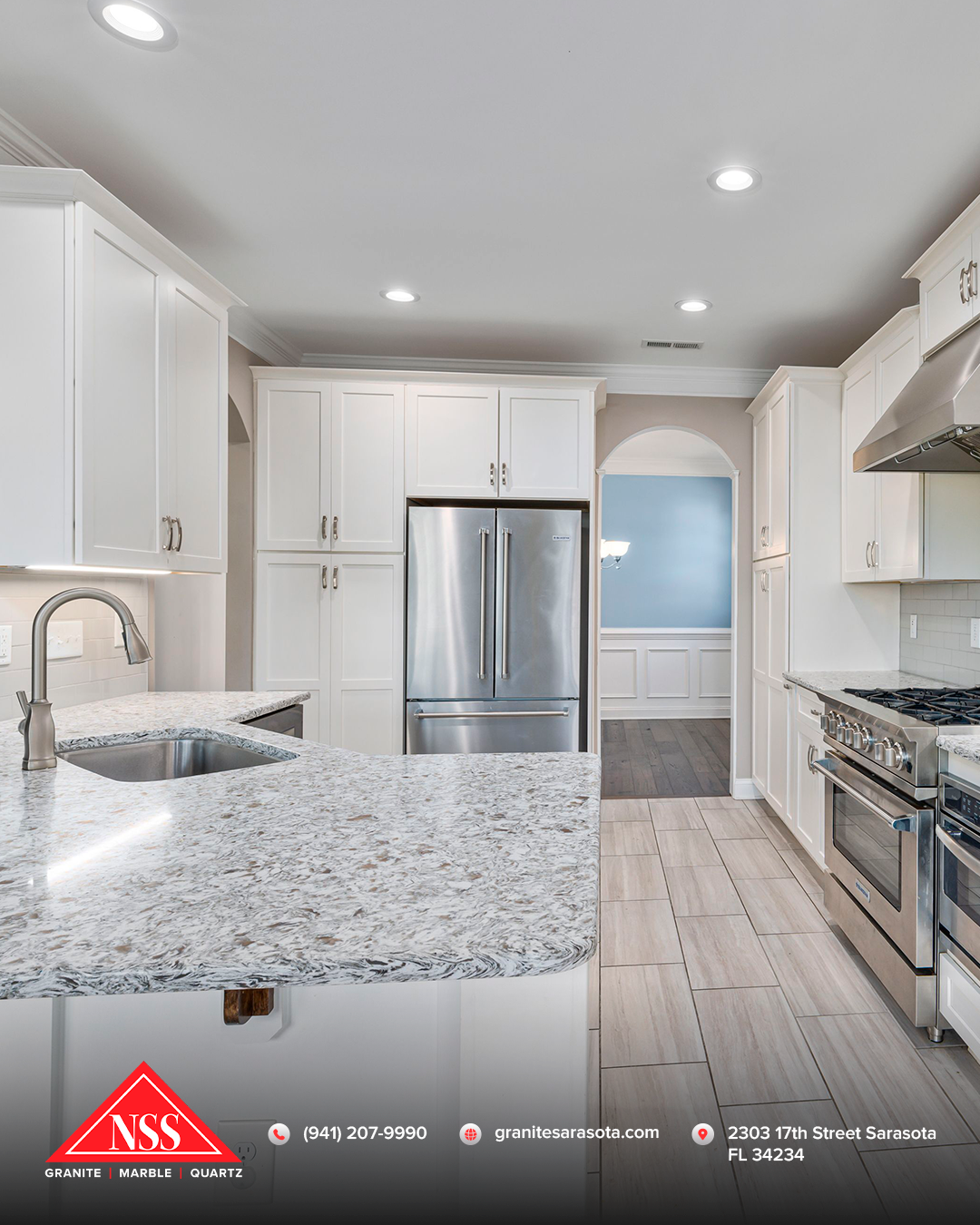
A kitchen can be beautiful and still feel visually exhausting. Too much contrast, too many sharp lines, or a countertop that demands attention from every angle can make the room feel busier than it really is.
For homeowners visiting granite countertop stores in Venice, FL, the most relaxing granite choices are usually warm, balanced, and moderately patterned rather than extremely dark or highly dramatic. At NSS, we look at how the stone works with cabinets, flooring, backsplash, daylight, and the objects that stay on the counter every day.
What Granite Makes a Kitchen Feel More Relaxed?
Granite with soft to medium movement, warm neutral undertones, and moderate contrast usually creates the calmest result.
Warm white, cream, greige, beige-gray, soft taupe, and muted gray granite can give the kitchen natural depth without making every surface compete. Medium movement is especially useful because it adds character while helping crumbs, water spots, and ordinary residue blend into the background between cleanups.
| Granite feature | Why it feels calmer | Best use |
|---|---|---|
| Soft to medium movement | Adds depth without visual noise | Perimeters and islands |
| Warm neutral base | Reduces harsh contrast | White or wood cabinets |
| Low to medium contrast | Keeps the eye moving smoothly | Open kitchens |
| Polished or satin finish | Adds controlled light | Average-size kitchens |
| Leathered finish | Reduces glare | Large islands |
A relaxing countertop is not necessarily plain. It simply gives the eye fewer hard stops.

Why Can Dramatic Granite Make a Kitchen Feel Busier?
Dramatic granite can make a kitchen feel busier when bold mineral movement competes with cabinet grain, backsplash pattern, flooring, and decor.
A high-contrast slab can work in a simple room, but it may feel overwhelming beside wood grain, patterned tile, open shelving, and countertop appliances.
When we help homeowners evaluate granite countertop stores in Venice, FL, we ask what else will remain visible after installation. The countertop should not be selected as if the room will stay empty.
Which Granite Colors Feel the Most Relaxing?
Warm white, cream, greige, beige-gray, soft taupe, and muted warm gray usually feel the most relaxed.
These colors avoid extreme contrast and pair easily with white oak, walnut, painted cabinets, black fixtures, and stainless appliances.
| Granite color family | Visual effect | Works especially well with |
|---|---|---|
| Warm white | Bright but soft | Dark or medium wood |
| Cream | Comfortable and natural | Warm wood and beige tile |
| Greige | Balanced and flexible | White or painted cabinets |
| Beige-gray | Calm and grounded | Mixed warm/cool finishes |
| Soft taupe | Warm without looking brown | White oak and black accents |
| Muted warm gray | Quiet and current | Cream, white, or walnut cabinets |
In Venice, FL, strong daylight can intensify both undertones and contrast. We prefer to review samples in natural light whenever possible because a stone that looks gray in a showroom may appear much warmer near a sunny window.
Does Granite Pattern Matter More Than Color?
Sometimes, yes. A quiet color with extremely heavy movement can feel more active than a slightly darker stone with a softer pattern.
Fine speckling, broad movement, and moderate mineral variation usually feel calmer than repeated sharp lines or several competing colors.
At NSS, we often recommend looking at the full slab from six to ten feet away. That distance reveals whether the granite reads as one balanced surface or a collection of separate visual events.
What Finish Makes Granite Feel Less Busy?
Leathered, satin, and softly polished finishes can all feel calm, depending on the stone and room.
Polished granite reflects more light, while leathered granite reduces glare. Satin finishes sit between the two.
| Finish | Glare level | Visual character | Practical note |
|---|---|---|---|
| Polished | Higher | Bright and crisp | Easy to wipe |
| Leathered | Lower | Soft and tactile | Texture needs proper cleaning |
| Honed | Low | Matte and quiet | Oils can show on some dark stones |
| Satin | Moderate | Balanced | Availability varies by stone |
The finish should be chosen with the room’s lighting, not in isolation.
How Does a Relaxing Granite Hide Everyday Mess?
A relaxing granite often has enough movement to soften the appearance of crumbs, water drops, fingerprints, and minor residue.
Very solid black and bright white surfaces can make ordinary mess more obvious. Medium-tone granite with mixed minerals makes crumbs and water rings less visually dominant between cleanups.
How Should Granite Work With the Backsplash?
The countertop and backsplash should not both compete for attention.
If the granite has visible movement, a quiet backsplash in warm white, cream, greige, or a tone pulled from the slab usually works best.
Homeowners shopping granite countertop stores in Venice, FL should also consider grout lines. A highly patterned granite below busy tile with dark grout can create more visual activity than expected.
How Do Granite, Quartz, Marble, and Quartzite Feel Different in a Calm Kitchen?
Granite provides natural mineral movement, quartz offers controlled consistency, marble gives softer veining, and quartzite often brings larger natural movement.
Quartz is non-porous and needs no sealing. Granite and quartzite have excellent heat resistance and usually need sealer checks. Marble can etch from lemon juice, vinegar, wine, tomato sauce, and some cleaners.
| Material | Visual character | Heat resistance | Maintenance | Calm-kitchen strength |
|---|---|---|---|---|
| Granite | Natural mineral variation | Excellent | Moderate | Forgiving movement |
| Quartz | Controlled pattern | Moderate | Low | Consistency |
| Marble | Soft natural veining | Good | Higher | Gentle visual depth |
| Quartzite | Strong natural movement | Excellent | Moderate | Natural focal point |
At NSS, we do not assume granite is automatically the right answer just because a client first asks for it. If low maintenance matters more than natural variation, quartz may fit better. If natural aging is part of the appeal, marble may still be right.
How Much Do Granite Countertops Cost?
Granite generally costs about $45-$120+ per square foot installed. Quartz typically ranges from $55-$140+, marble from $70-$180+, and quartzite from $80-$200+.
| Material | Typical installed range | Main cost drivers |
|---|---|---|
| Granite | $45-$120+ per sq. ft. | Slab, edge, cutouts, finish |
| Quartz | $55-$140+ per sq. ft. | Brand, pattern, slab size |
| Marble | $70-$180+ per sq. ft. | Grade, veining, finish |
| Quartzite | $80-$200+ per sq. ft. | Slab rarity, layout, fabrication |
When homeowners price granite countertop stores in Venice, FL, we recommend checking what is actually included. Digital templating, fabrication, faucet holes, sink cutouts, cooktop cutouts, edge finishing, sealing, backsplash fabrication, delivery, and installation can all affect the final number.
What Edge Profiles Help a Kitchen Feel Calmer?
Simple edge profiles usually create the calmest result.
An eased edge, pencil edge, or small bevel adds less visual weight and is easy to wipe around busy prep and sink areas.
What Services Matter Before the Granite Is Installed?
Accurate templating, slab layout, seam planning, edge finishing, and professional installation all affect the final result.
A complete project may include:
- Material and finish consultation
- Digital templating
- Slab or remnant layout planning
- Sink and cooktop cutouts
- Faucet-hole drilling
- Edge fabrication and polishing
- Seam and corner planning
- Backsplash or waterfall fabrication
- Sealing when needed
- Delivery and professional installation
At NSS, we review the full layout before fabrication because even a calm stone can feel awkward if a seam interrupts movement in the wrong place or the strongest section of the slab lands in an unexpected area.
How Long Does a Granite Countertop Project Take?
Most granite countertop projects take about 10-14 business days from final templating to installation when the selected material is available.
Material selection may take 1-5 days, layout review 1-2 days, and fabrication 5-10 business days. Installation is often completed in one day.
| Project stage | Typical timing |
|---|---|
| Material selection | 1-5 days |
| Digital templating | One appointment |
| Layout review | 1-2 days if needed |
| Fabrication | 5-10 business days |
| Installation | Usually one day |
Before templating, cabinets should be installed, level, secured, and permanent. Sink, faucet, cooktop, appliances, overhangs, edge profile, backsplash direction, and waterfall details should also be finalized.
What Mistakes Make a Kitchen Feel Less Relaxed?
The biggest mistakes are stacking too many patterns, using extreme contrast everywhere, and choosing the countertop without considering daily life.
We recommend avoiding:
- Busy granite with an equally busy backsplash
- High-contrast stone in a small room already full of detail
- Very glossy dark granite under strong direct lighting
- Choosing from a small sample without seeing full-slab movement
- Ignoring cabinet and flooring undertones
- Selecting a dramatic edge when the room already has many decorative details
A kitchen does not become calmer because every surface is beige. It becomes calmer when the materials stop fighting each other.
What Granite Works Best for a Family Kitchen?
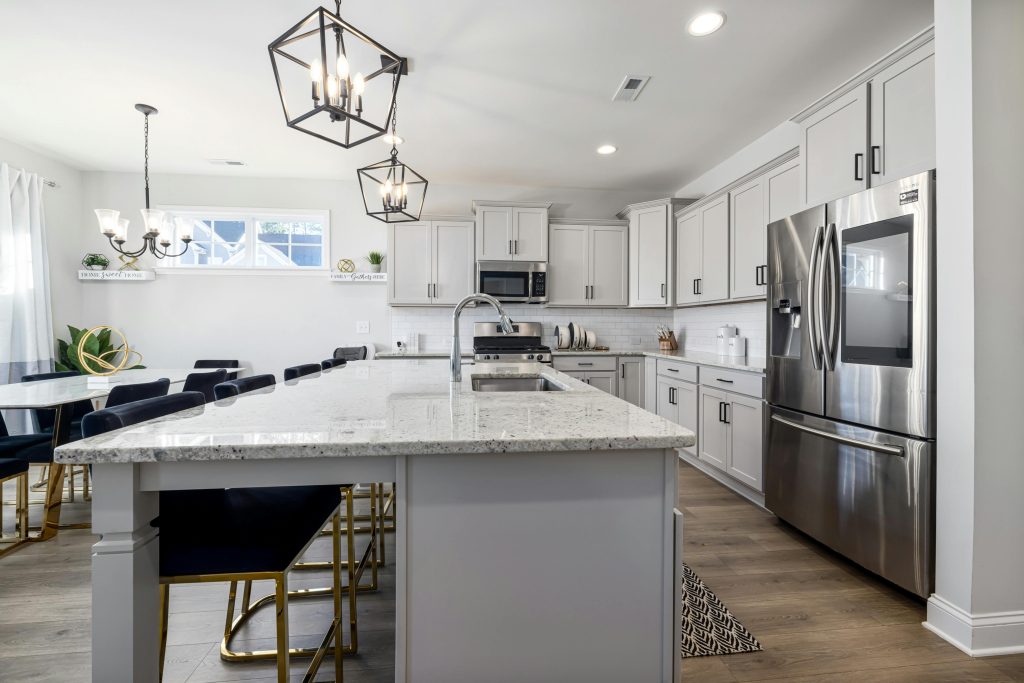
Medium-movement granite in warm or balanced neutral tones is usually the easiest choice for a family kitchen.
It hides ordinary mess, handles heat well, and adds natural variation without becoming the room’s main feature.
For homeowners researching granite countertop stores in Venice, FL, we often suggest starting with the cabinet and floor colors, then narrowing the granite based on movement and finish. That order usually produces a more balanced room than falling in love with a slab first and forcing everything else to fit around it.
FAQ
What granite color makes a kitchen feel calmer?
Warm white, cream, greige, beige-gray, soft taupe, and muted warm gray usually create the most relaxed visual effect.
Is busy granite bad for a small kitchen?
Not always, but strong movement can make a small kitchen feel more visually crowded if the cabinets, flooring, or backsplash are already detailed.
Is polished or leathered granite calmer-looking?
Leathered granite usually has less glare and feels softer, while polished granite reflects more light. The better choice depends on room size and lighting.
Does granite hide crumbs well?
Medium-movement granite often hides crumbs, water spots, and light residue better than very solid white or black surfaces.
How much does granite cost?
Granite typically costs about $45-$120+ per square foot installed, depending on slab, finish, edge, cutouts, backsplash, sealing, and installation conditions.
How long does granite installation take?
Most projects take about 10-14 business days from final templating to installation when material is available.
Does granite need sealing?
Most granite benefits from periodic sealer checks, although the schedule depends on the stone, sealer, and amount of daily use.
About NSS
We are located at 2303 17th Street, Sarasota, FL 34234. Homeowners can reach us at (941) 207-9990.
From Sarasota, FL, we serve Venice, FL and nearby communities with granite selection, digital templating, slab and remnant planning, custom fabrication, cutouts, faucet-hole drilling, edge finishing, backsplash and waterfall fabrication, sealing, delivery, and professional installation. We also work with quartz, marble, and quartzite.
For homeowners choosing granite countertop stores in Venice, FL, we help narrow the options by color, movement, finish, lighting, cabinet tone, maintenance expectations, pricing, and fabrication details so the finished kitchen feels easier to live in, not visually louder.