

Yes, quartz can look better without marble-style veining when a kitchen needs calm color, subtle texture, or a cleaner architectural surface. Wide gray veins are not the only way to create an upscale countertop. Soft solids, fine mineral patterns, concrete looks, warm limestone-inspired colors, and dark soapstone-style designs can feel more personal and better connected to the rest of the room.
We explain this to homeowners selecting quartz countertops in Venice Gardens, FL because marble-look quartz is only one part of the category. At NSS, we consider cabinet grain, flooring, lighting, room size, seam locations, and daily use before recommending a pattern.
Why Has Marble-Look Quartz Become So Common?
Marble-look quartz became popular because it combines visible movement with easier maintenance than natural marble.
Many homeowners like white stone with gray, taupe, or gold veins. Quartz delivers that appearance without routine sealing, and it is less likely than marble to develop etching from lemon juice, vinegar, wine, or tomato sauce.
The problem is that the style has become extremely familiar. When similar veins appear on every island, backsplash, and showroom display, the material can feel predictable.
A countertop does not need to imitate marble to look complete. In some kitchens, removing the dramatic pattern allows better cabinetry, lighting, and proportions to become more noticeable.
What Quartz Styles Work Without Marble Veining?
The strongest alternatives include soft solids, fine aggregates, concrete-inspired colors, limestone looks, dark soapstone-style surfaces, and terrazzo patterns.
These products still contain visual depth. Their movement is simply smaller, softer, or distributed more evenly across the slab.
| Quartz style | Typical appearance | Where it works best |
|---|---|---|
| Soft solid | Nearly uniform with slight tonal variation | Minimal kitchens and colorful cabinets |
| Fine aggregate | Small mineral flecks | Busy family kitchens |
| Concrete-inspired | Cloudy gray, greige, or taupe | Modern and industrial spaces |
| Limestone-inspired | Warm, low-contrast movement | Natural wood cabinetry |
| Soapstone-inspired | Charcoal or black with restrained detail | Traditional or moody kitchens |
| Terrazzo-style | Visible chips in a controlled background | Playful or mid-century interiors |
When comparing quartz countertops in Venice Gardens, FL, we recommend standing several feet away from the full slab. Quiet patterns often look more interesting at room scale than they do in a small sample.
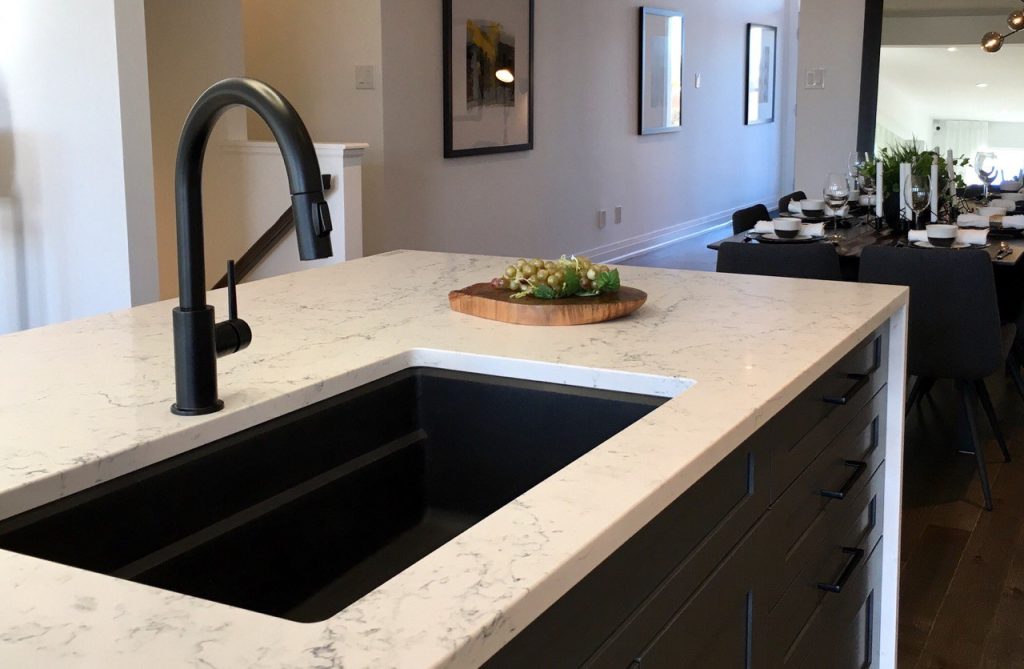
Can Nearly Solid Quartz Look Luxurious?
Yes, nearly solid quartz can look luxurious when its color, finish, edge profile, and installation are handled precisely.
A warm off-white countertop can make walnut or white oak cabinets look richer. A charcoal surface can create a clean line beneath cream cabinetry without introducing another busy pattern.
Quiet quartz also exposes workmanship. Seams, wall gaps, uneven caulk, and inconsistent edges are easier to notice when no large vein distracts the eye.
That makes accurate templating and fabrication especially important. The luxury comes from proportion and execution rather than from the size of the pattern.
Why Can Fine-Patterned Quartz Be Better for Daily Use?
Fine-patterned quartz often hides crumbs, water spots, and minor wiping marks better than pure white or solid black.
A small mineral pattern provides visual forgiveness without creating strong direction. It also makes seams easier to place because there is no major vein that must continue perfectly across the joint.
| Quartz appearance | What it tends to reveal | Daily practicality |
|---|---|---|
| Pure white | Crumbs, coffee rings, colored residue | Moderate |
| Solid black | Dust, fingerprints, water spots | Moderate |
| Fine aggregate | Minor crumbs and light streaks | High |
| Soft clouding | Water spots and residue | High |
| Wide veining | Fewer small marks, but more visible seams | Moderate |
This is useful when several people use the kitchen, children work at the island, or meals are prepared throughout the day.
Which Quiet Quartz Works Best With Wood Cabinets?
Warm white, taupe, greige, limestone-inspired, and soft charcoal quartz usually work well with unpainted wood.
Oak, walnut, cherry, and hickory already contain grain and natural movement. Adding wide marble-style veins can cause the cabinet pattern and countertop pattern to compete.
Quiet quartz gives the wood more visual space. It also makes future changes to hardware, paint, or backsplash materials easier.
| Cabinet material | Quartz styles that often work |
|---|---|
| White oak | Warm white, greige, limestone-inspired |
| Walnut | Cream, pale taupe, quiet charcoal |
| Hickory | Fine aggregate or soft solid |
| Cherry | Warm cream, muted gray, soapstone look |
| Painted green or blue | Soft white or fine mineral pattern |
| White cabinetry | Taupe, charcoal, concrete-inspired |
We always compare the slab with an actual cabinet door when possible. Phone photographs can distort undertones.
Is Non-Veined Quartz Better in a Small Kitchen?
Quiet quartz often works better in a compact kitchen because it creates continuity across short countertop sections.
A large vein may be divided by the sink, range, refrigerator, or inside corners. Only fragments of the intended pattern remain visible, which can make the layout feel accidental.
A soft solid or fine aggregate reads as one continuous surface. It can make separate countertop runs feel more connected.
For quartz countertops in Venice Gardens, FL, we consider the number of interruptions as carefully as the room’s square footage. A small kitchen with one uninterrupted peninsula may support more movement than a large kitchen divided into many short sections.
Can Quiet Quartz Work on a Large Island?
Yes, quiet quartz can make a large island feel more architectural and substantial.
Without one bold line controlling the eye, the island is read as a complete shape. This works especially well with thick mitered edges, fluted wood panels, integrated seating, or statement pendant lights.
Nearly solid quartz can also support a strong cabinet color. Navy, dark green, walnut, and black islands often look more balanced beneath a restrained countertop.
The result is not empty. It is controlled.
Does Quiet Quartz Hide Seams Better?
Fine aggregate and softly clouded quartz generally hide seams better than high-contrast directional patterns.
A seam becomes more visible when a large vein stops, changes angle, or meets an unrelated section. Smaller patterns reduce that visual interruption.
| Pattern type | Typical seam visibility | Layout difficulty |
|---|---|---|
| Fine aggregate | Low | Low |
| Soft clouding | Low | Low to moderate |
| Near-solid light color | Moderate | Moderate |
| Near-solid dark color | Moderate to high | Moderate |
| Wide directional veining | High | High |
A good pattern cannot correct a poorly fabricated seam. The joint still needs to be tight, level, supported, and coordinated with an appropriate adhesive color.
Does Quartz Need Veins to Look Natural?
No, quartz can look natural through layered color, mineral flecks, soft clouding, and a low-sheen finish.
Natural stone is not always dramatically veined. Limestone, soapstone, many granites, and some quartzites show granular movement or broad tonal variation rather than long marble-like lines.
Quartz inspired by those materials may look more convincing than a flat white background with oversized printed veins. The best designs contain several related tones instead of one uniform base color.
At NSS, we examine the full slab for repeated sections, abrupt pattern stops, and areas that may look artificial after cutting.
How Does Finish Change Quiet Quartz?
Finish changes how strongly a subtle pattern reflects light and how visible everyday contact becomes.
Polished quartz appears brighter and usually shows greater color depth. Matte and honed-style finishes reduce glare and can make concrete, limestone, and soapstone-inspired products feel more natural.
| Finish | Visual effect | Maintenance consideration |
|---|---|---|
| Polished | Bright and reflective | Easy to wipe; may show glare |
| Matte | Soft and contemporary | Oils may show on dark colors |
| Honed-look | Natural and restrained | Requires complete wiping |
| Textured | More tactile depth | Fine residue may need extra cleaning |
We recommend touching dark matte samples before ordering. Fingerprints and hand oils may be more noticeable than they appear on a perfectly clean display.
How Does Quartz Compare With Granite, Marble, and Quartzite?
Quartz provides the most controlled appearance and easiest sealing routine, while natural stone offers unique movement and stronger heat performance.
| Material | Pattern character | Sealing | Heat resistance | Stain resistance |
|---|---|---|---|---|
| Quartz | Engineered and predictable | No | Moderate | Excellent |
| Granite | Mineral-rich and unique | Usually | Excellent | Very good when sealed |
| Marble | Soft natural movement | Usually | Good | Moderate |
| Quartzite | Crystalline and varied | Usually | Excellent | Very good when sealed |
Granite can provide natural movement without marble-style veins. Marble develops etching and patina. Quartzite offers excellent heat and scratch resistance but usually costs more.
Quartz remains practical when the priorities are controlled color, no periodic sealing, and reliable stain resistance.
Can Quartz Handle Heat and Stains?
Quartz resists most household stains well, but concentrated heat can damage its resin binders.
Coffee, cooking oil, wine, and tomato sauce usually clean easily when removed within a reasonable time. Permanent marker, hair dye, solvents, and strong chemicals can be more difficult.
Hot cookware should be placed on trivets. We also recommend heat-resistant mats beneath air fryers, toaster ovens, slow cookers, and electric skillets.
Quartz is durable, but it should not be treated as heat-proof.
How Much Does Quartz Cost?
Quartz generally costs about $55–$140 or more per square foot installed.
Quiet quartz is not automatically cheaper than dramatic quartz. Manufacturer, product tier, finish, slab size, availability, and fabrication requirements affect the price more than vein size alone.
| Material | Typical installed range |
|---|---|
| Granite | $45–$120+ per sq. ft. |
| Quartz | $55–$140+ per sq. ft. |
| Marble | $70–$180+ per sq. ft. |
| Quartzite | $80–$200+ per sq. ft. |
Homeowners pricing quartz countertops in Venice Gardens, FL should compare full project totals rather than material rates alone. Sink and cooktop cutouts, edge profiles, seams, backsplashes, removal, delivery, and installation all influence the final amount.
At NSS, we prepare estimates after reviewing the actual cabinet layout and selected product.
What Is Included in Professional Fabrication?
Professional fabrication includes measuring, slab planning, cutting, edge finishing, cutouts, seam preparation, delivery, and installation.
A typical project may include:
- Material and finish consultation
- Digital templating
- Full-slab layout review
- Sink and cooktop cutouts
- Faucet-hole drilling
- Edge fabrication
- Seam planning
- Backsplash or waterfall fabrication
- Delivery and installation
- Final care instructions
At NSS, we pay close attention to seam color and edge consistency on quiet surfaces because those details remain highly visible without bold veining.
How Long Does Quartz Fabrication Take?
Most quartz projects take approximately 10–14 business days from final templating to installation.
| Project stage | Typical timing |
|---|---|
| Material selection | 1–5 days |
| Digital templating | One appointment |
| Layout review | 1–2 days if needed |
| Fabrication | 5–10 business days |
| Installation | Usually one day |
| Plumbing reconnection | Same day or next day |
Before measuring quartz countertops in Venice Gardens, FL, cabinets should be installed, level, secured, and in their permanent positions. Sink, faucet, range, and cooktop specifications should also be final.
What Selection Mistakes Should Homeowners Avoid?
The biggest mistakes are assuming subtle means boring, choosing from a tiny sample, and ignoring finish or surrounding materials.
Avoid:
- Selecting pure white without testing how it shows crumbs
- Choosing solid black without checking fingerprints
- Pairing cool concrete quartz with warm wood without samples
- Ignoring seam placement on near-solid colors
- Assuming larger veins always look more expensive
- Combining several strong patterns in one room
- Selecting material under only showroom lighting
- Approving a color without viewing the full slab
Quiet quartz works best when color, texture, edge work, and installation are all deliberate.
FAQ
Is non-veined quartz less expensive?
Not necessarily. Brand, product tier, slab size, finish, and availability affect the price more than the pattern style.
Which quiet quartz hides dirt best?
Fine aggregate, warm taupe, and softly clouded patterns usually hide minor crumbs and water spots well.
Does quartz require sealing?
No. Engineered quartz is non-porous and does not require periodic sealing.
Is solid white quartz difficult to maintain?
It is easy to clean, but crumbs, coffee rings, and colored residue may remain highly visible.
Can matte quartz show fingerprints?
Yes, especially in darker colors. We recommend handling a finish sample before ordering.
Can quiet quartz hide seams?
Fine and clouded patterns generally disguise seams better than wide directional veins.
Is quartz safe behind a range?
Yes, when required clearances and manufacturer instructions are followed. Direct high heat should be avoided.
How long does quartz installation take?
Most projects take about 10–14 business days after final templating.
About NSS
We are located at 2303 17th Street, Sarasota, FL 34234. Homeowners can reach us at (941) 207-9990.
From Sarasota, FL, we serve Venice Gardens, FL and nearby communities with material selection, digital templating, pattern layout, custom fabrication, sink and cooktop cutouts, edge finishing, backsplash fabrication, delivery, and professional installation. We work with quartz, granite, marble, and quartzite for kitchens, islands, bathrooms, vanities, waterfall panels, and other residential surfaces.
For homeowners considering quartz countertops in Venice Gardens, FL, we help compare soft solids, fine aggregates, concrete looks, soapstone-inspired colors, finishes, pricing, seam placement, and installation details so the final surface feels intentional without relying on marble-style veining.